National Capital Area Chapter Annual Meeting

The National Capital Area Chapter (NCAC) will hold its Annual Meeting on Tuesday, May 13, 2025 from 7:00 to 8:30 p.m. Our meeting will be conducted virtually by Zoom. All chapter members are invited to attend. Please join us for the keynote address from Bob Lavigna, Senior Fellow with Public Sector for UKG, who will speak on the timely topics of “2025 Megatrends” and successful leadership behaviors. We will also announce annual chapter award recipients and student essay contest winners. We will conclude with the State of the Chapter Address by chapter president Dale Jones.

Agenda

Welcome Remarks (7:00-7:05 p.m.)

  • Delivered by: Dale Jones, President

Keynote Speech (7:05-7:40 p.m.)

  • Moderated by: Judy England-Joseph, Past-President
  • Speaker: Bob Lavigna, Senior Fellow, Public Sector for UKG
  • Title: “2025 Megatrends: A Roadmap for the Future of the Public Sector” and “9 Leadership Behaviors that Create Great Places to Work”
  • Discussion and Conversation
  • Q&A

Chapter Awards (7:40-7:55 p.m.)

  • Moderated by: Judy England-Joseph, Past-President

Francis Kelsey Award recipient announced

  • Remarks from recipient (5 minutes)

NCAC Award for Outstanding Public Service announced

  • Remarks from recipient (5 minutes)

NCAC 2024-2025 Public Administration Student Essay Contest (7:55-8:15 p.m.)

  • Program Directors: Joshua Lanier, Vice President, and Allen Lomax, Member-at-Large
  • Moderated by: Allen Lomax, Member-at-Large

First Place Winner ($2,000) announced

Second Place Winner ($1,500) announced

  • Remarks from First Place Winner (8 minutes)


State of the Chapter Address (8:15-8:30 p.m.)

  • Delivered by: Dale Jones, President


Click here to register for the meeting: https://www.eventbrite.com/e/aspa-ncac-chapter-annual-meeting-on-may-13-2025-tickets-1341300308329?aff=oddtdtcreator

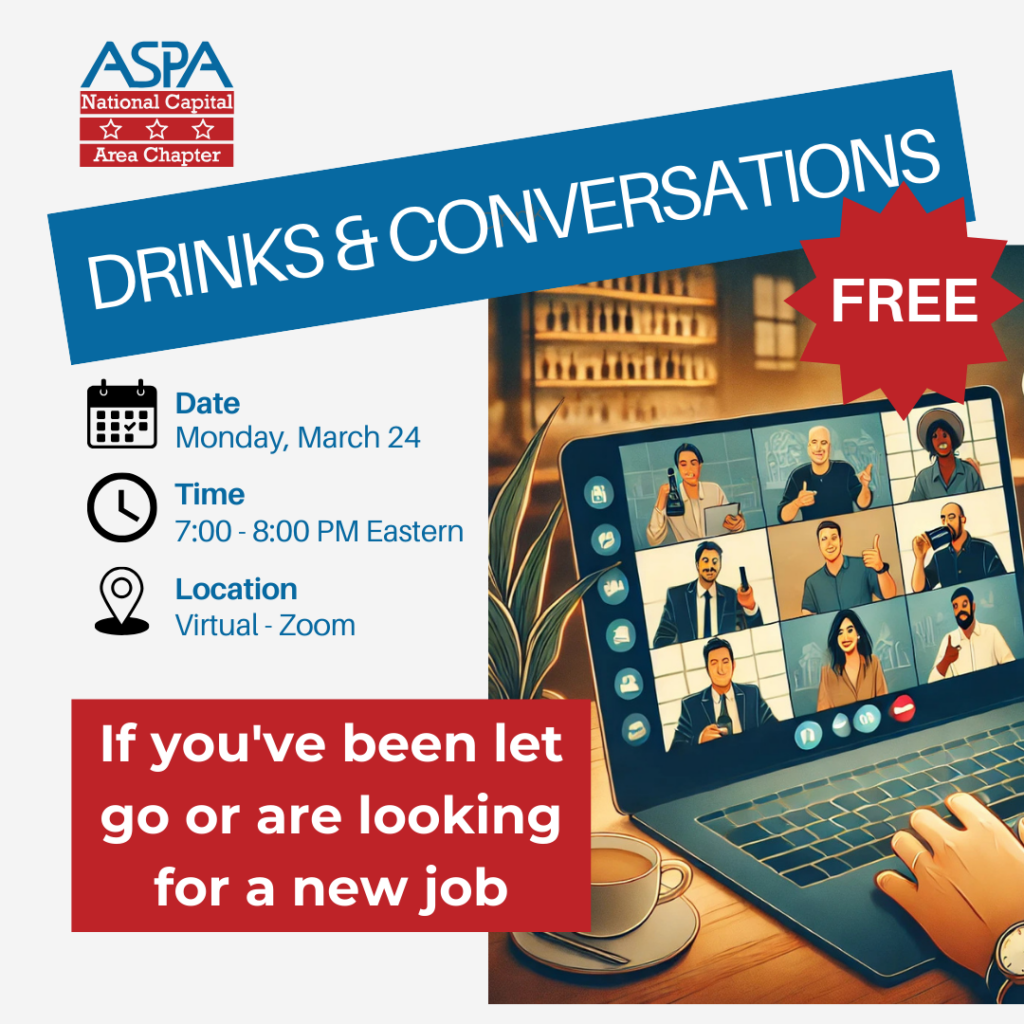
Drinks & Conversation: If you’ve been let go or are looking for a new job

Date: Monday, March 24

Time: 7:00 – 8:00 PM Eastern

Location: Virtual – Zoom

Free

On Monday, March 24th, the National Capital Area Chapter will host its next “Drinks and Conversation” session.

If you have been laid off or are feeling anxious about your future in the current environment, then hit the register button below. This will be a safe space where you can share your feelings and get tips and strategies for moving forward. Belva Martin and Judy England Joseph, retired Senior Executives and NCAC members, will share practical strategies to help you navigate the days ahead, including using your networks for support, updating your resume, and practicing healthy self-care.

Invite friends, family, and other colleagues who might benefit from this information sharing session. We hope this session will remind you that you’ve chosen to be part of a community that can support you. It’s likely to equip you with tips for thriving, not just surviving. This most informal of our session formats lends itself to the discovery of potential new friends and mentors, so please bring a drink and come hang out with your colleagues.

Register for this free event here: https://www.eventbrite.com/e/drinks-conversation-let-go-looking-for-a-new-job-come-chat-with-us-tickets-1278246542819?aff=oddtdtcreator

Join NCAC at ASPA’s Annual Conference!

ASPA 2025Submitted by NCAC President, Dale Jones

ASPA’s 2025 Annual Conference will take place in person in Washington, DC, at The Mayflower Hotel during March 28 to April 1. The conference is the premier professional development event for those who practice, teach, or study public administration. The conference features 150 panels across six tracks examining this year’s theme: “Not Robots Yet: Keeping Public Servants in Public Service.”

For more information and to register to attend for in-depth conversations, research presentations, workshops, networking and so much more, please click here: https://aspanet.org/Conference2025/Conference2025/Home.aspx

Our National Capital Area Chapter is sponsoring two events at this year’s conference.

Reception & Relationships: First-Timers and Others!
Friday, March 28 | 6:30 p.m. – 8:00 p.m. | Chinese Ballroom

Sponsored by the Iowa Chapter, the National Capital Area Chapter, Kitty Wooley (NCAC Board Member), and ASPA.

This session is dedicated to all who wish to jump-start their conference participation over light hors d’oeuvres and facilitated conversation. By the time you leave the room, you”ll have met colleagues whose experience of public service is like and unlike your own. That will expand your circle and increase the possibilities for good times over the next few days and lasting professional connections after everyone goes home. First-timers and old hands, academics and practitioners, introverts and extroverts, local
residents and far-flung members—you'll encounter them all. Please join us for a heartfelt welcome to ASPA 2025.


Trust in Government Presidential Panel
Sunday, March 30 | 3:45 p.m. – 5:00 p.m. | Room TBD

Sponsored by the National Capital Area Chapter.

Presenters:
Katherine Barrett and Richard Greene, Moderator and Presenter, Principal, Barrett and Greene, Inc.
Lura Forcum, President, Independent Center
Nick Mastronardi, Cofounder and CEO, Polco
Mark McDaniel, Deputy City Manager, Fort Worth Texas

If someone comes down with a bad case of the flu, they would be disinclined to tell friends that they were “healthy because they did not have pneumonia.” That is exactly how the critical issue of trust in state and local government is couched when compared to the situation in the federal government. Data demonstrates that though states and localities are more trusted than the federal government, levels of faith in these institutions have been on the wane in recent years. This session will dig deep into the best data available about this topic and explore the reasons why trust in government is such an important issue. It also will consider a variety of ways states and localities can bolster residents’ faith in government services, including heightened transparency; access to government officials and people who directly provide services; engendering citizen engagement; skillful use of social media; and more.

Volunteers for ASPA 2025 Annual Conference

Volunteers can receive a complimentary conference registration. To support the conference, ASPA would love it if some NCAC folks want to volunteer. This option is open to student and retiree ASPA members. If you would like to volunteer, please contact the ASPA conference staff at aspaconference@aspanet.org to receive more information. They would be happy to assist and would appreciate your support. Anyone who serves as a volunteer must work at least 16 hours of time in support of the conference to receive a free registration. Types of jobs needed include working at the registration desk, assisting with hallway monitoring and session set-up, providing general customer service, and helping with pre-conference set-up (bag stuffing, etc.).

AABPA Budget Panel: The Role of OMB

No Comments

AABPA Budget Panel: The Role of OMB 

Tags: Tags: ,

AABPA Budget Panel: Evidence-Based Policy and the Budget Process

cross-post with the American Association for Budget and Program Analysis

The past 20 years have seen real growth in the body of social programs rigorously shown to produce important gains in educational/economic mobility and other life outcomes. How can the government identify and fund those programs – and build new ones, through rigorous testing – to make real headway on the nation’s social problems? We will discuss how evidence-based policy can be incorporated into the budget process with Jon Baron, the President of the Coalition for Evidence Based Policy.

Registration Link: 

https://us02web.zoom.us/meeting/register/tZ0sduqhrT8oG9A8SqrZrrZsftC8oZckWvi0


Join us for our monthly budget panel!

Andy Pavord

President

American Association for Budget and Program Analysis

Wine & Cheese Gathering

The National Capital Area Chapter is changing things up with an in-person-only event in ASPA’s conference room on November 20th from 4 to 6 p.m.

Board members, led by Joshua Lanier (2024 Vice President) and Allen Lomax (Living Legends of Alexandria 2012 inductee) will be on hand to ensure that this is a vibrant occasion.

Wine and cheese will be furnished by John Sporing, 2020 recipient of the Boyce Award for distinguished service to the regional science profession and CEO & Chief Taster of A Life Well Drunk LLC.

All three people have interesting stories to tell. If you prefer quiet one-on-one time, that will also work! If you can be in town that day, we hope to see you.

Register here no later than 11/19 by 4:00p.m.

NOTE: All who plan to attend must register below at least 24 hours in advance, so that your name can be added to the list at the guard station in the lobby and you can be escorted upstairs to the conference room.

Creating Safe Spaces in the Workplace: Key Takeaways from Our Oct. 24th Discussion

Summary respectfully submitted by Kitty Wooley, Keesha Gill, and Whitney Meyerhoeffer

In today’s evolving workplace, cultivating a safe environment for open, honest communication is essential for organizational success. Recently, the National Capital Area Chapter of the American Society of Public Administrators hosted a Drinks and Conversations discussion on “Creating Organizational Safe Spaces.” To prioritize trust and camaraderie of these specific events we did not record it, however, here are some of the key insights and strategies shared.

Understanding Different Perspectives on Safety

One major takeaway was the idea that safety in the workplace isn’t universal. What feels safe to leaders may not feel safe to employees at other levels. Leaders must recognize that their position may afford them a sense of security not shared by everyone in the organization. Being mindful of these differences is the first step in fostering an inclusive environment where all voices are valued.

Beyond the Meeting Room

Organizational safety extends beyond what happens in formal meetings. Employees notice how leaders interact with them in all contexts, and these day-to-day interactions set the tone for trust. Actions outside the meeting room are just as important as the discussions within it; they reveal whether leaders truly value openness and mutual respect.

Leveraging Third-Party Feedback Channels

The group discussed the value of third-party facilitators in collecting employee feedback. A neutral party can often build more trust and foster greater honesty, as employees may feel more comfortable sharing their experiences and concerns. Many organizations, such as the U.S. Department of State and the Nuclear Regulatory Commission (NRC), offer anonymous reporting systems to encourage openness while protecting individual identities. This approach can help leaders receive honest feedback without employees fearing potential repercussions.

The Importance of Acting on Feedback

Feedback is only as effective as the response it generates. When employees see that their input leads to tangible action, it strengthens trust and demonstrates that their voices are valued. Leaders should be careful not to react defensively or dismiss feedback; this can discourage future input and create an unsafe environment.

Recognizing the Cost of Silence

Failing to foster open communication can have a financial impact. When employees do not feel safe speaking up, issues can remain unresolved, leading to inefficiencies and budget implications and high turnover rates. Professional skepticism—encouraging employees to question processes and suggest improvements—was highlighted as a key element in creating an innovative, responsive organization.

Taking Action Before Issues Escalate

By the time a workplace’s issues are visible from the outside, it’s often too late to easily remedy them. Addressing problems internally before they become public ensures a healthier work culture and protects the organization’s reputation. Leaders should actively listen to concerns, rather than assume they already have the full picture. As one participant noted, letting go of the “IKEA effect” (the bias of believing that, because you built something, you know best) can help leaders become more receptive to feedback and uncover blind spots they might have missed.

Using Tools like 360 Reviews Wisely

Some agencies use 360-degree reviews to gather a well-rounded perspective on employee performance and satisfaction. When done correctly, these reviews can be a valuable tool for uncovering hidden issues and fostering a culture of accountability and continuous improvement. The group discussed limitations to the 360 review when the sample is so broad that the process becomes cumbersome and time-consuming.

Future Discussions: Giving and Receiving Feedback

In response to interest from participants, future events in this series may delve into topics such as effectively giving and receiving feedback in the workplace. These discussions will further explore how leaders and employees can improve their communication skills to create a safer, more productive environment for all.


Creating an organizational safe space isn’t easy, but the benefits are undeniable. By taking these insights to heart, leaders and employees alike can work together to build workplaces where everyone feels empowered to contribute. Thank you to all who joined the discussion and shared their valuable experiences and ideas!
Drinks & Conversation: “Organizational Safety”

In today’s workplace, fostering an environment where employees feel comfortable sharing their thoughts, concerns, and ideas is critical to organizational success. We will discuss practical strategies and insights on how to cultivate a culture of open and honest communication, where voices are heard and valued. Whether you are an experienced administrator or new to leadership, this event offers an opportunity to discuss with colleagues, learn from one another and share your experiences.

This session follows September 10th’s dynamic, intergenerational discussion on “Horrible Bosses: How to Navigate a Toxic Workplace“. A recap has been posted at https://aspancac.org/recap-of-horrible-bosses-how-to-navigate-a-toxic-workplace/ for those who were unable to participate.

“Drinks and Conversation,” the most informal of our offerings, lends itself to the discovery of potential new friends and mentors, so please bring a drink, put your feet up, and come hang out with your colleagues!

Register at: https://www.eventbrite.com/e/aspa-ncac-hosts-organizational-safety-tickets-1035193089397?aff=oddtdtcreator

Please RSVP! Only those who RSVP received the link!

Recap of “Horrible Bosses: How to Navigate a Toxic Workplace”

Recap submitted by NCAC Board Members, Kitty Wooley and Whitney Meyerhoeffer

On Tuesday, September 10th, the National Capital Area Chapter of the American Society of Public Administrators held a virtual Drinks and Conversations networking event.

Our Drinks and Conversations events arose out of the pandemic when the Board felt it was a good idea to have an open event where our colleagues in public administration could get together and talk about the issues we were facing in a relaxed environment. These events became a wonderful staple of our programming during the pandemic and have kept going with lively discussions. In the past year, the chapter has begun introducing themed Drinks and Conversations events that propose a topic for the discussion. The spirit of the networking event, where we share our experiences with candor and discuss strategies to handle issues, is still ever-present. If you’ve been to one of our Drinks & Conversations events you know this is a time for us to tip our drinkware and have open discussions about a topic.

This week’s event topic was Horrible Bosses: How to Navigate a Toxic Work Environment.

We’ve all heard stories—or perhaps lived them—of challenging work environments, difficult supervisors, or navigating office politics. 

Throughout the 1-hour event, attendees did not just listen; but engaged in an open, honest conversation about their own experiences. The group shared stories, asked questions, and offered each other support and a few strategies to navigate and overcome the obstacles that can make workplaces feel toxic.

We had meaningful and lively discussions and learned from one another’s journeys. 

This event is as much about connecting as it is about learning new strategies. 

This event was not recorded to be mindful of folks sharing experiences and to create a safe open space for sharing.

A member recounted how productivity in his situation ground to a halt under toxic leadership. Several other members shared strategies they used to try and effect change, some still trying to make changes even as they were exiting the job.

Questions arose about why these people do these things.

  1. They have personal agendas.
  2. Something is going on in their lives.
  3. They have some sort of lack of self-esteem, lack of confidence, or they are intimidated by something.
  4. Other reasons

There were also a few books mentioned relative to discussions about leadership, and how to a) be a successful leader and b) how to give and receive feedback to help improve yourself and others in the workplace.

Out of these discussions, as is often the case, other topics for future Drinks and Conversations events were proposed. One that we all agreed would be good to have soon is how to create a safe space for feedback (Thank you, Belva Martin!)

The main takeaways from the event and the most important bullet points the group wanted to make sure everyone knew:

  1. You are not suffering alone. It can feel very lonely and helpless in a toxic workplace. But always know, you are not alone in your struggle. There are others out there on similar journeys and it is essential that you know you aren’t alone and you don’t have to do this alone.
  2. It is important to find allies inside or outside of work. Find a trusted colleague at work or attend a networking event outside of work to find allies. Having a person to lean on, to talk to, or to vent and take a walk with is important to helping you get through this challenging time. The mental work it takes to manage difficult situations is taxing and giving ourselves the grace and space to process is important.
  3. Sometimes leaving has its own impact. While not always the case, choosing to leave your job can be a signal to higher-ups that there is an issue. Strategies such as mentioning to a higher-up leader that the reason you are leaving is because of a toxic situation can have an impact. Other times you can make HR aware that there is a reason why you are leaving. But even if you just leave and say nothing, there is an impact.
  4. Sometimes you learn more from the horrible manager. You learn who you are as a leader or what you are looking for in a company culture. You know the signs of a toxic workplace and can look for them in the future. You also are learning how you do not want to be treated, which in turn helps you be a better leader in the future.
  5. Organizations and businesses with bad leadership are not sustainable. Over time, poor leadership affects productivity, creativity, and teamwork. 

It was a great discussion and a helpful event with support and compassion.

Look for our next Drinks and Conversations event with the topic of creating safe spaces for feedback in the workplace.

Conversation: Students & New to Midcareer Professionals

The ASPA National Capital Area Chapter board plans to run 2-3 experimental breakouts this year, beginning with a July 10th session intended for the chapter’s student and newer professional members.

Background: NCAC is considering adding an additional mode, small group conversation via Zoom breakout rooms, to its programming portfolio.  This mode could be used to strengthen the chapter and support members further through conversations focused on flash mentoring, reverse mentoring, colloquia, retrospectives, or simply getting to know each other better.

The objective for the July session is to provide small conversational spaces for participants to (a) start getting to know each other and (b) share ideas about topics and how events are structured.

The session will begin with everyone together.  After the chapter welcome, our emcee will facilitate introductions and explain the session flow before everyone is transferred to breakout rooms for discussion.  Each room will have a facilitator to help keep things moving.

Participants will come back together to report on programming ideas and discuss the breakout experience.  We will repeat the process to gather ideas on new ways to structure sessions.  The session will help your board begin to update and expand offerings for all NCAC members.

If you consider yourself to be a student or new to midcareer academic or practitioner, please join us for this session to meet your colleagues and contribute to future programming.  No one will be turned away.  If you cannot attend, feel free to email your ideas to the programming chair at kittywooley5@gmail.com, who will share them with other board members.

Click here to register

Tags: Tags: ,