Bringing AI to Main Street: What It Means for Communities and Public Service

Written by NCAC Board Member, Ryan Heimer

As artificial intelligence (AI) continues to reshape industries and institutions, its most profound impacts may not be felt in Silicon Valley or Washington, D.C., but on “Main Street”—in the cities, towns, and communities where public services are delivered and local economies thrive. A recent discussion led by Brenna Isman of the National Academy of Public Administration (click here to view the recording) offers a timely and grounded look at how AI is transforming public administration at the local level—and what it will take for communities to succeed. 

AI’s Promise—and Its Limits 

At the national level, projections suggest AI could significantly boost productivity and economic growth over the next decade. But as Isman emphasized, those gains are not guaranteed at the local level. Communities must take deliberate steps to ensure AI-driven benefits are equitably distributed and aligned with local needs. 

Rather than eliminating jobs outright, AI is more likely to reshape the nature of work—automating routine tasks while enabling workers to focus on higher-value responsibilities. However, this transition brings real risks, particularly for workers in roles susceptible to automation. The takeaway is clear: adaptation,not avoidance,is the path forward. 

Understanding the AI Ecosystem 

The report introduces a helpful framework for understanding how AI operates within communities. It identifies three key groups: 

  • Innovators, who develop AI technologies 
  • Implementers, who apply those technologies in real-world settings
  • Enablers, who provide the infrastructure, policy support, and resources needed to sustain AI systems 

No single group can drive success alone. Effective AI adoption depends on coordination across sectors, including government, private industry, academia, and civil society. 

What Makes a Community “AI-Ready”? 

  1. Strong Digital Infrastructure Reliable broadband, cloud computing capacity, and modern power grids are foundational. Without these, AI adoption simply cannot scale. From digital literacy to advanced technical training, communities must invest in reskilling and upskilling their workforce. Partnerships with universities, community colleges, and even public libraries are proving critical. 
  2. Workforce Development
  3. Open Data and Governance High-quality data is the fuel of AI. But as participants noted, “garbage in, garbage out” remains a real concern. Effective data governance, transparency, and privacy protections are essential to building trust and ensuring ethical use. 
  4. Community Engagement Perhaps most importantly, successful communities treat AI not as something done to them, but something developed with them. Town halls, surveys, and public forums help ensure that residents understand—and help shape—the role of AI in their lives. 

Opportunities and Tradeoffs 

Communities that are successfully integrating AI tend to share several core characteristics: AI is already improving service delivery in areas such as customer service, lending decisions, and municipal operations. Case examples highlighted uses ranging from AI-powered loan processing in Kansas City to automation in manufacturing and recycling in California.

But these benefits come with tradeoffs. One of the most debated issues is the rise of data centers, which are essential to AI infrastructure but raise concerns about energy consumption, water usage, and environmental impact. Some states are even considering moratoriums on new data center development as they weigh economic benefits against community costs. 

The Workforce Question 

A particularly striking insight from the research is that AI often delivers the greatest productivity gains for less experienced workers, helping close performance gaps. This underscores the importance of accessible training programs and inclusive workforce strategies. Encouragingly, communities of all sizes are finding creative ways to build capacity. Smaller towns, often in partnership with nearby universities, are offering training programs and leveraging free tools such as online learning platforms. The common thread is not size or wealth—but commitment and creativity.

Governance, Ethics, and Trust 

As AI adoption accelerates, questions of governance loom large. Who ensures systems are fair? Who audits algorithms? How do we prevent bias and protect privacy? 

Emerging policies—such as requirements for chatbots to disclose that they are AI—signal a growing recognition of these challenges. Still, many public organizations are only beginning to grapple with the need for robust governance frameworks, ethical guardrails, and accountability mechanisms. For public administrators, this represents both a challenge and an opportunity: to shape AI in a way that reflects the values of equity, transparency, and public service. 

A Call to Action 

The overarching message from the discussion is one of urgency balanced with responsibility: 

  • Start now—waiting increases the risk of falling behind 
  • Invest in foundations—infrastructure, workforce, and governance
  • Center equity—ensure all communities benefit, not just the most resourced
  • Collaborate widely—no single entity can do this alone 

For communities like those in Appalachia and across West Virginia, the stakes are especially high. AI presents an opportunity to overcome long-standing barriers in education, healthcare, and economic development—but only if implemented thoughtfully and inclusively. 

Looking Ahead 

AI is not a distant future—it is already reshaping how governments operate and how communities function. The question is not whether to engage with AI, but how to do so responsibly. As public servants, the task ahead is clear: to ensure that this powerful technology strengthens, not undermines, the trust, effectiveness, and humanity at the heart of public service.

Recap of Federal Employees to Be Honored at Community Coffee Event in Beckley

On April 18, 2026, Young Government Leaders (YGL) hosted a Federal Employee Appreciation Coffee Event at Chocolate Moose in Beckley, West Virginia. As part of YGL’s broader national initiative to recognize and uplift public servants, the event offered a space for connection, conversation, and community among federal employees in the region.


The event was organized and hosted by Ryan Heimer, a member of the American Society for Public Administration National Capital Area Chapter (NCAC), where he serves as Communications Officer. Demonstrating a strong commitment to public service and community engagement, Ryan led local coordination efforts, brought together key partners, and helped ensure that attendees had access not only to a welcoming environment, but also to meaningful resources.


Among those partners was Fayette Federal Credit Union, which supports federal employees across the region. Their involvement highlighted the importance of local institutions in sustaining and supporting the federal workforce, particularly in communities like Beckley. By connecting attendees with practical financial resources and services, the event extended beyond appreciation to tangible support.


While attendance was modest, the event underscored an important truth: meaningful engagement does not require a large crowd. The smaller setting created an environment where attendees could connect more personally by sharing stories from their careers, reflecting on the challenges facing today’s federal workforce, and reaffirming a shared commitment to public service.


A highlight of the event was the participation of the American Federation of Government Employees (AFGE) Women’s and Fair Practices Department. Their presence brought added depth to the gathering by providing valuable resources and information focused on workplace equity, employee rights, and support systems available to federal workers. Their engagement complemented YGL’s mission by ensuring attendees left not only feeling appreciated, but also better informed and supported.


Throughout the morning, conversations touched on professional development, navigating change within federal service, and the importance of building strong networks—particularly in smaller communities like Beckley. Events like this reinforce that public service is not just about the work itself, but about the people who carry it forward every day.


The Beckley coffee event reflects YGL’s and AFGE’s continued commitment to reaching federal employees where they are, from across agencies, regions, and roles. Through leadership, partnership, and intentional outreach, even small gatherings can create lasting impact. YGL is helping to strengthen the fabric of public service—one conversation, one connection, and one community at a time.

Categories: Event, Latest News, NCAC

New and Returning Board Members Bring Deep Public Service Experience and Fresh Energy

The chapter’s board includes a strong mix of nonprofit leadership, long-term federal service, local government expertise, higher education, and organizational development. Creating a well-rounded team focused on stability, growth, and member value in the year ahead.

Whitney Meyerhoeffer works in the nonprofit sector and is especially focused on helping the chapter strengthen sustainable governance. Her priority is building durable practices that support continuity and long-term effectiveness.

Connie Berhane brings three decades of federal government experience. She is committed to supporting membership growth and closely monitoring participation trends over the upcoming year to ensure the chapter remains strong in key membership areas.

Judy England-Joseph has served as a federal employee since 1975, retiring from U.S. Government Accountability Office and continuing her work today by helping organizations improve employee engagement. She is interested in supporting chapter programming and contributing her experience to strengthen member-facing activities.

Dale Jones, serves as the immediate past president and brings a diverse background spanning the United States Air Force, higher education, and executive coaching. His focus is on ensuring smooth leadership transitions, supporting the new president and board, and helping sustain ongoing work already in progress.

Keesha Gill works in human services with Fairfax County Government. She plans to provide operational support to the board, particularly through organizing administrative processes and maintaining board files to keep the chapter’s work efficient and well-documented.

Joshua Lanier has more than 15 years of federal government experience and currently works with the United States Secret Service in a congressional committee context. He supports the board’s essay contest and brings a creative side as someone who enjoys photography and beach travel.

Dennis McBride, teaches at Georgetown University and has a background in behavioral neuroscience and experimental psychology. He is interested in helping the board with strategy and long-range thinking.

Hao Sun is a tenure-track assistant professor at Gallaudet University, where he teaches economics, business, finance, and public policy. His research focuses on public finance, international economic development, and comparative public policy, with work examining budgeting, fiscal institutions, and sustainable economic governance. As a newer member of the board, he is interested in strengthening connections between academic research and the public service community while expanding opportunities for student and early-career engagement.

Katherine McKinney recently began a new role with Washington State Government, where she is establishing a project management office. She is eager to support programming and membership efforts, with a special focus on ensuring members feel welcomed, valued, and connected.

Steven Putansu is a public servant at the US Government Accountability Office (GAO), a professorial lecturer at American University, an author, and a public management scholar. He tries to find connections between research and practice, and across academic fields and disciplines, to advocate for thoughtful development and use of policy knowledge in government decisions.

Ryan Heimer earned an MPA last year and works in the coalfields supporting the health and safety of coal miners. He is interested in contributing through chapter communications—especially by helping with the newsletter and assisting with written comments and advocacy-oriented writing when needed.

Allen Lomax has served on the NCAC Board since 2013, when he was appointed by ASPA National’s Board of Directors to help revitalize the chapter. His work with the City of Alexandria has helped inform chapter discussions on key issues such as affordable housing and the opioid crisis, while also bringing valuable intergovernmental perspectives to NCAC programming.

Together, this group blends experience and enthusiasm. Strengthening the chapter’s leadership capacity, supporting effective transitions, and expanding the board’s ability to deliver meaningful programs and a welcoming member experience.

Categories: Leadership, NCAC

NCAC Officers and Members of the Board of Directors for 2026-2027

2 Comments

ASPA National Capital Area Chapter (NCAC) members elected four officers and eight at-large members for the Board of Directors. Voting took place during December 5-19. Board members will serve a two-year term beginning January 1, 2026 and ending December 31, 2027.

Members of the next NCAC Board of Directors are listed below:
Officers of the Board (4)
President, Whitney Meyerhoeffer
Vice President, Joshua Lanier
Treasurer, Steven Putansu
Secretary, Keesha Gill

At-Large Members of the Board (8)
Connie Berhane
Ryan Heimer
Dr. Dale Jones (Immediate Past-President)
Judy England-Joseph
Allen Lomax
Dr. Dennis McBride
Katherine McKinney
Dr. Hao Sun

Dr. Dale Jones, outgoing President who will continue to serve on the Board in the role of Immediate Past-President, stated, “I thank current Board members for their dedicated and excellent service during the past two years and welcome new Board members for the next term. We are fortunate to have a Board with members who have extensive experience and
work together collaboratively to best serve our Chapter members.”

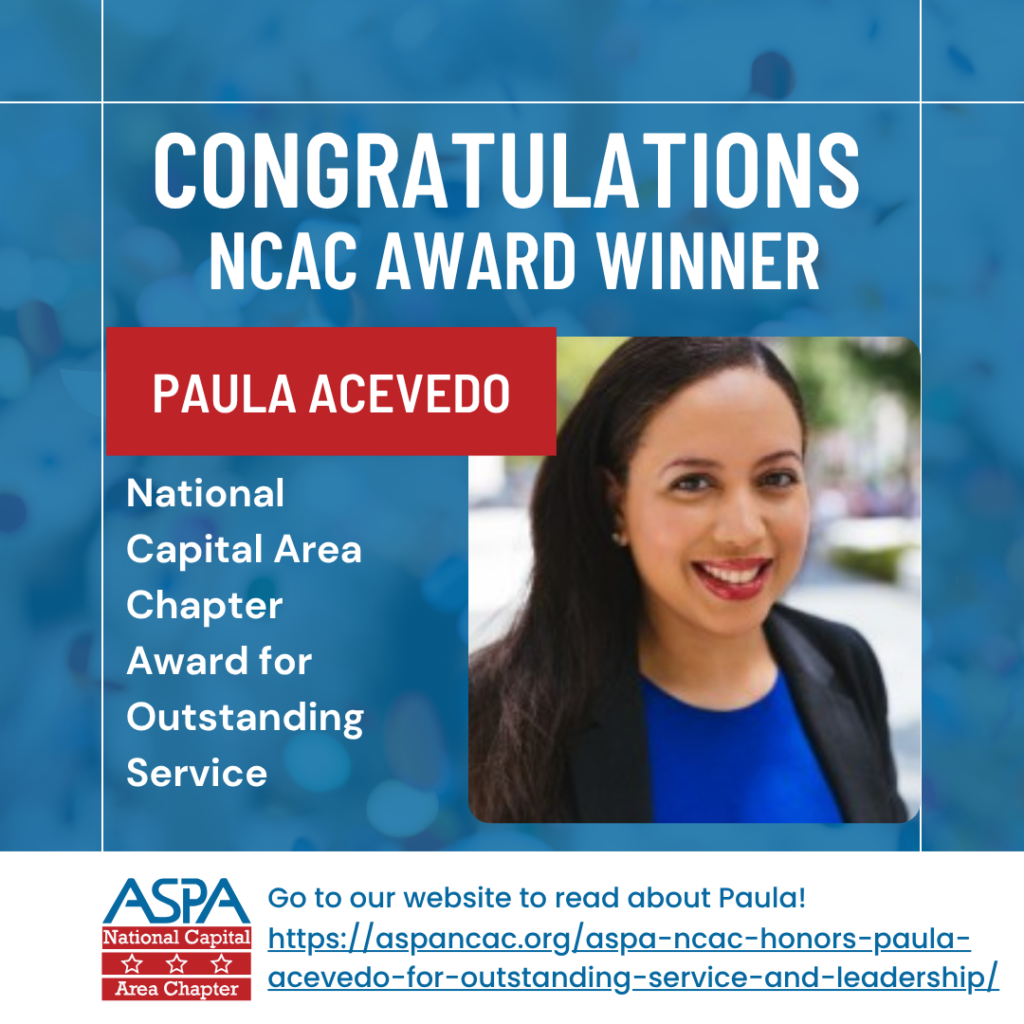
Additionally, he expressed, “I thank and extend my appreciation to the members of the Nominating Committee and Elections Committee for their excellent and timely conduct of the elections process.”  Nominating Committee members were Allen Lomax (Chair), Pablo Alcala, and John Palguta with support from Paula Acevedo and Whitney Meyerhoeffer.  Elections Committee members were Kitty Wooley (Chair), Paula Acevedo, Connie Berhane, Dale Jones, and Allen Lomax.

Categories: ASPA News, NCAC

Derrick Boakye Boadu Wins First Place in the 2025 Student Essay Contest

headshot of Derrick Boadu

Derrick Boadu

NCAC congratulates Derrick Boakye Boadu for winning First Place of the National Capital Area Chapter’s (NCAC) 2025 Public Administration Student Essay Contest for his essay Public Administration in the Age of AI: A Dual Approach for Scholars and Practitioners.”


Derrick Boakye Boadu is a Ph.D. Candidate at the Florida International University, Steven J. Green School of International and Public Affairs and along with the distinction of the essay winning the Chapter’s Essay Contest, will receive a cash award of $2,000 that we hope will go toward furthering your education and a three-year membership to the American Society for Public Administration.


Derrick joined us at our Chapter’s Annual Meeting on May 13 to discuss his essay and express his gratitude for being selected.


You can view the recording of our Annual Meeting by clicking here.


Congratulations, Derrick, on winning First Place for your essay in our Chapter’s 2025 Student Essay Contest!

Pablo D. Alcala Wins Second Place in the 2025 Student Essay Contest

Pablo D. Alcala headshot

Pablo D. Alcala

NCAC congratulates Pablo Alcala for winning Second Place of the National Capital Area Chapter’s (NCAC) 2025 Public Administration Student Essay Contest for his essay Can Expanding Opportunities Reduce Crime? Exploring the Link between Social Equity and Security.


Pablo Alcala is a Ph.D. Candidate at the University of Maryland, and along with the distinction of the essay winning the Chapter’s Essay Contest, will receive a cash award of $1,500 that we hope will go toward furthering your education and a three-year membership to the American Society for Public Administration.


Pablo joined us at our Chapter’s Annual Meeting on May 13 to discuss his essay and express his gratitude for being selected.


You can view the recording of our Annual Meeting by clicking here.


Congratulations, Pablo, on winning Second Place for your essay in our Chapter’s 2025 Student Essay Contest!

NCAC Congratulates Board Member Dr. Wendy Chen on Multiple Milestones

Headshot of Dr. Wendy Chen

Dr. Wendy Chen

The National Capital Area Chapter of the American Society for Public Administration would like to take a moment to celebrate the incredible accomplishments of our board treasurer, Dr. Wendy Chen. This year has been a banner year for Dr. Chen and our chapter is proud to celebrate and promote her work!


A New Chapter 

Dr. Chen has worked diligently and thoroughly and is excited that her book, Innovation and Entrepreneurship in the Public Sector, published by Oxford University Press, will be released later this year. Look for an announcement from NCAC about a possible local book release event in late summer or early fall. Dr. Chen’s book first gives a history of public innovation from around the world. Then, she uses data and real-life examples to discuss lessons of public innovation.  More importantly, this book provides actionable strategies for the public sector to push innovation. She shows that public leaders are not only civil service workers- but are entrepreneurs in their own right that can create a culture of innovation to bring about change.


A Career Milestone

Another outstanding accomplishment, Dr. Chen recently became a tenured professor at Texas Tech University! She is an expert in various areas within public administration including technology and government innovation, public and nonprofit leadership, local governance, emergency management, and entrepreneurship, etc. She was recently honored with the prestigious Chester A. Newland award from Public Administration Review and is also the 2024 recipient of the Excellence in Science and Technology Research Award from the American Society of Public Administration.


Thought Leadership

Dr. Chen is a Senior Associate Editor of the Management Decision journal. It is a peer-reviewed and high-impact journal based in the UK and is the oldest academic journal that focuses on understanding management and leadership.

In her role, she is leading the new initiative “In Motion” to expand boundaries. Dr. Chen believes that lessons learned from practitioners and other sectors can be just as valuable as lessons from the private sector.


A Leader

Dr. Chen has worked diligently as the treasurer of our Board and is an active participant in our events, discussions, and promotions. NCAC is fortunate to have an innovative leader with fresh ideas and a holistic approach.


Final Thoughts & Congratulations

We congratulate Dr. Chen on her forthcoming book, being awarded tenure at Texas Tech University, and for her thought leadership in the Management Journal. Join us in congratulating Dr. Chen and look for news later this year about her book launch!

Chapter Board Members Attend ASPA Annual Conference in Washington, D.C.

NCAC Board Members at ASPA National Conference

Allen Lomax, member-at-large; Judy England-Joseph, past-president; and Dale Jones, president, enjoy a break among numerous sessions.

The 2025 ASPA Annual Conference was held in Washington, D.C. at The Mayflower Hotel during March 28 through April 1, 2025. Our National Capital Area Chapter (NCAC) co-sponsored with the Iowa Chapter a session titled “Reception and Relationships: First-Timers and Others!” on March 28. Wendy Chen, NCAC treasurer and session co-facilitator with Iowa Chapter representative Tom Becker, moderated the overflow audience at the session designed to jump-start conference participation and conversations.

NCAC Board Members at ASPA Annual Conference

Kitty Wooley, director of programming, joins Dale Jones and Allen Lomax outside one of the conference sessions at the historic Mayflower Hotel.

The NCAC also sponsored a presidential panel on March 30 titled “Trust in Government.” Overall, both sessions and the entire Annual Conference were exceedingly successful. Photographs show members of the NCAC Board of Directors attending the Annual Conference. Allen Lomax, member-at-large; Judy England-Joseph, past-president; and Dale Jones, president, enjoy a break among numerous sessions. Wendy Chen, treasurer, is shown socializing with attendees at the reception co-sponsored by NCAC. Kitty Wooley, director of programming, joins Dale Jones and Allen Lomax outside one of the conference sessions at the historic Mayflower Hotel.

NCAC Treasurer, Wendy Chen at ASPA Annual Conference

Wendy Chen, treasurer, is shown socializing with attendees at the reception co-sponsored by NCAC.

Photographs show members of the NCAC Board of Directors attending the Annual Conference.

Join NCAC at ASPA’s Annual Conference!

ASPA 2025Submitted by NCAC President, Dale Jones

ASPA’s 2025 Annual Conference will take place in person in Washington, DC, at The Mayflower Hotel during March 28 to April 1. The conference is the premier professional development event for those who practice, teach, or study public administration. The conference features 150 panels across six tracks examining this year’s theme: “Not Robots Yet: Keeping Public Servants in Public Service.”

For more information and to register to attend for in-depth conversations, research presentations, workshops, networking and so much more, please click here: https://aspanet.org/Conference2025/Conference2025/Home.aspx

Our National Capital Area Chapter is sponsoring two events at this year’s conference.

Reception & Relationships: First-Timers and Others!
Friday, March 28 | 6:30 p.m. – 8:00 p.m. | Chinese Ballroom

Sponsored by the Iowa Chapter, the National Capital Area Chapter, Kitty Wooley (NCAC Board Member), and ASPA.

This session is dedicated to all who wish to jump-start their conference participation over light hors d’oeuvres and facilitated conversation. By the time you leave the room, you”ll have met colleagues whose experience of public service is like and unlike your own. That will expand your circle and increase the possibilities for good times over the next few days and lasting professional connections after everyone goes home. First-timers and old hands, academics and practitioners, introverts and extroverts, local
residents and far-flung members—you'll encounter them all. Please join us for a heartfelt welcome to ASPA 2025.


Trust in Government Presidential Panel
Sunday, March 30 | 3:45 p.m. – 5:00 p.m. | Room TBD

Sponsored by the National Capital Area Chapter.

Presenters:
Katherine Barrett and Richard Greene, Moderator and Presenter, Principal, Barrett and Greene, Inc.
Lura Forcum, President, Independent Center
Nick Mastronardi, Cofounder and CEO, Polco
Mark McDaniel, Deputy City Manager, Fort Worth Texas

If someone comes down with a bad case of the flu, they would be disinclined to tell friends that they were “healthy because they did not have pneumonia.” That is exactly how the critical issue of trust in state and local government is couched when compared to the situation in the federal government. Data demonstrates that though states and localities are more trusted than the federal government, levels of faith in these institutions have been on the wane in recent years. This session will dig deep into the best data available about this topic and explore the reasons why trust in government is such an important issue. It also will consider a variety of ways states and localities can bolster residents’ faith in government services, including heightened transparency; access to government officials and people who directly provide services; engendering citizen engagement; skillful use of social media; and more.

Volunteers for ASPA 2025 Annual Conference

Volunteers can receive a complimentary conference registration. To support the conference, ASPA would love it if some NCAC folks want to volunteer. This option is open to student and retiree ASPA members. If you would like to volunteer, please contact the ASPA conference staff at aspaconference@aspanet.org to receive more information. They would be happy to assist and would appreciate your support. Anyone who serves as a volunteer must work at least 16 hours of time in support of the conference to receive a free registration. Types of jobs needed include working at the registration desk, assisting with hallway monitoring and session set-up, providing general customer service, and helping with pre-conference set-up (bag stuffing, etc.).

Creating Safe Spaces in the Workplace: Key Takeaways from Our Oct. 24th Discussion

Summary respectfully submitted by Kitty Wooley, Keesha Gill, and Whitney Meyerhoeffer

In today’s evolving workplace, cultivating a safe environment for open, honest communication is essential for organizational success. Recently, the National Capital Area Chapter of the American Society of Public Administrators hosted a Drinks and Conversations discussion on “Creating Organizational Safe Spaces.” To prioritize trust and camaraderie of these specific events we did not record it, however, here are some of the key insights and strategies shared.

Understanding Different Perspectives on Safety

One major takeaway was the idea that safety in the workplace isn’t universal. What feels safe to leaders may not feel safe to employees at other levels. Leaders must recognize that their position may afford them a sense of security not shared by everyone in the organization. Being mindful of these differences is the first step in fostering an inclusive environment where all voices are valued.

Beyond the Meeting Room

Organizational safety extends beyond what happens in formal meetings. Employees notice how leaders interact with them in all contexts, and these day-to-day interactions set the tone for trust. Actions outside the meeting room are just as important as the discussions within it; they reveal whether leaders truly value openness and mutual respect.

Leveraging Third-Party Feedback Channels

The group discussed the value of third-party facilitators in collecting employee feedback. A neutral party can often build more trust and foster greater honesty, as employees may feel more comfortable sharing their experiences and concerns. Many organizations, such as the U.S. Department of State and the Nuclear Regulatory Commission (NRC), offer anonymous reporting systems to encourage openness while protecting individual identities. This approach can help leaders receive honest feedback without employees fearing potential repercussions.

The Importance of Acting on Feedback

Feedback is only as effective as the response it generates. When employees see that their input leads to tangible action, it strengthens trust and demonstrates that their voices are valued. Leaders should be careful not to react defensively or dismiss feedback; this can discourage future input and create an unsafe environment.

Recognizing the Cost of Silence

Failing to foster open communication can have a financial impact. When employees do not feel safe speaking up, issues can remain unresolved, leading to inefficiencies and budget implications and high turnover rates. Professional skepticism—encouraging employees to question processes and suggest improvements—was highlighted as a key element in creating an innovative, responsive organization.

Taking Action Before Issues Escalate

By the time a workplace’s issues are visible from the outside, it’s often too late to easily remedy them. Addressing problems internally before they become public ensures a healthier work culture and protects the organization’s reputation. Leaders should actively listen to concerns, rather than assume they already have the full picture. As one participant noted, letting go of the “IKEA effect” (the bias of believing that, because you built something, you know best) can help leaders become more receptive to feedback and uncover blind spots they might have missed.

Using Tools like 360 Reviews Wisely

Some agencies use 360-degree reviews to gather a well-rounded perspective on employee performance and satisfaction. When done correctly, these reviews can be a valuable tool for uncovering hidden issues and fostering a culture of accountability and continuous improvement. The group discussed limitations to the 360 review when the sample is so broad that the process becomes cumbersome and time-consuming.

Future Discussions: Giving and Receiving Feedback

In response to interest from participants, future events in this series may delve into topics such as effectively giving and receiving feedback in the workplace. These discussions will further explore how leaders and employees can improve their communication skills to create a safer, more productive environment for all.


Creating an organizational safe space isn’t easy, but the benefits are undeniable. By taking these insights to heart, leaders and employees alike can work together to build workplaces where everyone feels empowered to contribute. Thank you to all who joined the discussion and shared their valuable experiences and ideas!