Why I Serve: Marcos Fabian on Evidence, Institutions, and the Quiet Work of Public Service
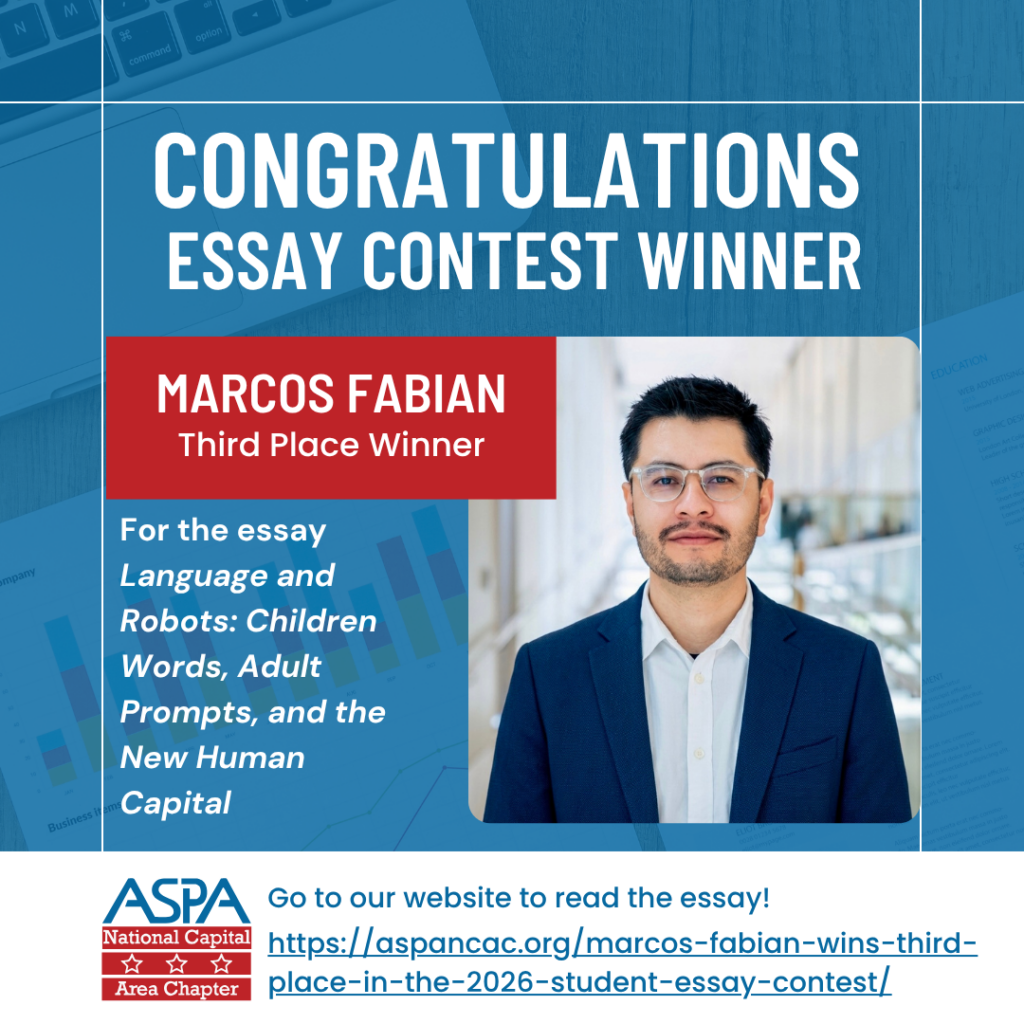
Featuring Marcos Fabian, PhD Candidate in Policy Analysis, University of Maryland School of Public Policy
Public administration is often most successful when the public never has to think about it. A bank remains stable. A family keeps its savings. A child receives an education. A public institution quietly performs the work it was created to do. For Marcos Fabian, a PhD candidate in Policy Analysis at the University of Maryland School of Public Policy, those often-unseen successes capture something fundamental about the meaning of public service.
Fabian’s path to public administration has taken him from Mexico City to College Park, Maryland, connecting practical experience inside public institutions with a growing commitment to rigorous policy research. Today, his academic work examines human capital formation and measures how environmental shocks affect children’s health and education.
But his understanding of public service began well before his doctoral studies.
Fabian started his professional career with the Association of Supervisors of Banks of the Americas in Mexico City, an international association of public institutions that brings together authorities responsible for banking supervision throughout the Americas. He spent five years leading the organization’s research unit.
It was there that he encountered a form of public service that rarely makes headlines.
When financial supervision works properly, Fabian observed, the results can be almost invisible.
People generally do not notice the bank that does not fail or the saver who does not lose a lifetime of deposits. Behind those outcomes, however, are public servants carrying enormous responsibilities. The supervisors Fabian worked alongside had devoted their careers to protecting financial systems and the people who depend upon them.
That experience shaped his understanding of what it means to serve.
Public service, in Fabian’s view, does not require an audience. Some of its most consequential work happens quietly, performed by professionals who place the interests of society ahead of their own and accept responsibility for protecting people they may never personally meet.
Public Institutions Changed His Life
Fabian’s commitment to service is also deeply connected to his own educational journey.
He recognizes that he has personally benefited from the very institutions that public administrators build and sustain. He was educated in public institutions, received scholarships and advanced academically because of the work of teachers, administrators and other public servants—many of whom he never met. Giving something back to those institutions and to society is consequently part of what motivates his career.
That sense of responsibility eventually led Fabian toward another dimension of public service: research.
His professional experiences demonstrated that policy decisions are only as strong as the evidence supporting them. Producing reliable evidence, however, requires more than collecting information. It requires rigorous methods, careful analysis and a willingness to distinguish between conclusions supported by evidence and assertions that are not.
For Fabian, that challenge has become increasingly important.
At a time when careful analysis can sometimes be treated as equivalent to unsupported claims, public administrators still must make decisions. Agencies still must act. Communities still depend upon institutions to solve problems, allocate resources and make choices with real consequences for people’s lives.
Fabian therefore sees his career at the intersection of two worlds: the practical experience of working within public institutions and the rigorous methods of policy research. By bringing those perspectives together, he hopes to better understand public policy and contribute meaningful evidence to decision-making.
His story is also a reminder that public administration encompasses far more than the people whose names appear in headlines. It includes researchers producing evidence, regulators protecting financial stability, educators expanding opportunity and administrators maintaining institutions that millions of people rely upon every day.
Sometimes the clearest evidence that public administration is working is precisely that nothing goes wrong.
That quiet responsibility—to protect people one may never meet, strengthen institutions and make decisions grounded in evidence—is at the heart of why Marcos Fabian serves.