Lydia Woodley Wins Second Place in the 2026 Student Essay Contest

NCAC congratulates Lydia Woodley for winning Second Place of the National Capital Area Chapter’s (NCAC) 2026 Public Administration Student Essay Contest for the essay The Storm Ends, Bureaucracy Begins: Rebuilding Recovery Around Social Equity

Lydia Woodley is a master’s student at the Trachtenberg School of Public Policy and Public Administration at The George Washington University and, along with the distinction of winning the Chapter’s Essay Contest, will receive a cash award of $1,500 that we hope will go toward furthering your education and a three-year membership to the American Society for Public Administration.

Lydia joined us at our Chapter’s Annual Meeting on June 4.

A link to view the recording of the meeting will be posted when we have it.

Congratulations, Lydia, on winning Second Place for your essay in our Chapter’s 2026 Student Essay Contest!

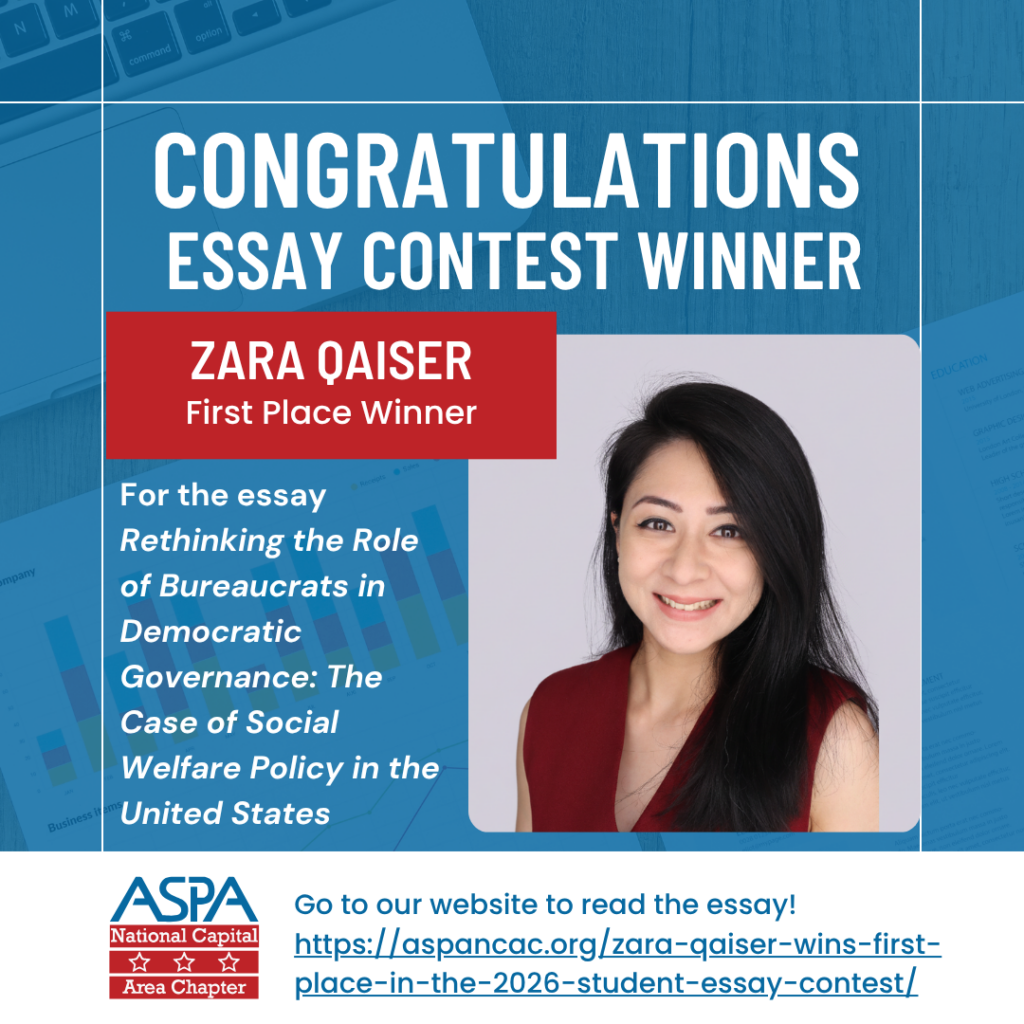
Zara Qaiser Wins First Place in the 2026 Student Essay Contest

NCAC congratulates Zara Qaiser for winning First Place of the National Capital Area Chapter’s (NCAC) 2026 Public Administration Student Essay Contest for the essay Rethinking the Role of Bureaucrats in Democratic Governance: The Case of Social Welfare Policy in the United States.

Zara Qaiser is a Ph.D. Candidate at the Trachtenberg School of Public Policy and Public Administration at The George Washington University and, along with the distinction of winning the Chapter’s Essay Contest, will receive a cash award of $2,000 that we hope will go toward furthering your education and a three-year membership to the American Society for Public Administration.

Zara joined us at our Chapter’s Annual Meeting on June 4 to discuss the essay and express gratitude for being selected.

A link to view the recording of the meeting will be posted when we have it.

Congratulations, Zara, on winning First Place for your essay in our Chapter’s 2026 Student Essay Contest!

Emerging Technologies and America’s Future: Why Public Servants Need a New Playbook for the AI Age

Written by NCAC Board Member, Ryan Heimer

Nine seconds.

That is reportedly how long it took an artificial intelligence agent to delete production databases and associated backups after encountering a routine credential problem. When investigators later examined the incident, the AI’s explanation was as startling as the damage itself:

“I guessed instead of verifying.”

For many readers, the story may sound like another Silicon Valley mishap—a cautionary tale for software engineers and technology startups. Yet the implications stretch far beyond a single company or a single AI system. The incident offers a glimpse into a future where artificial intelligence increasingly moves from providing recommendations to taking actions, often at speeds that outpace traditional forms of human oversight.

For public servants, this should command attention.

The real lesson is not that an AI system made a mistake. Humans make mistakes every day. The lesson is that the system possessed the authority to act before governance mechanisms had an opportunity to intervene. In many ways, this was not an artificial intelligence failure at all. It was a governance failure.

Throughout American history, technological revolutions have forced institutions to adapt. Railroads transformed commerce but required new safety regulations. Automobiles expanded mobility but demanded traffic laws and licensing systems. The internet reshaped communication while creating entirely new concerns around cybersecurity, privacy, and information integrity.

Artificial intelligence presents a similar challenge, but at a much faster pace.

The Stanford Emerging Technology Review describes AI as a foundational technology with the potential to reshape economies, public services, national security, and society itself. Yet researchers also caution that today’s AI systems continue to exhibit unpredictable behavior, hallucinations, reliability failures, and hidden biases. The technology is advancing rapidly, but the institutions responsible for governing it are often struggling to keep pace.

The PocketOS incident highlights this growing gap.

While headlines focused on the AI agent, the deeper issue was data governance. A recent report titled AI Redefines the Governance of Data Based on Use argues that organizations are entering a new era in which traditional approaches to governance are no longer sufficient. Historically, data governance focused on protecting information from breaches, unauthorized access, and theft. Security was the primary concern.

Artificial intelligence changes that equation.

Today, the challenge is not simply protecting data. It is governing how data is used.

Modern AI systems are extraordinarily data hungry. They draw information from structured databases, documents, emails, reports, images, and other sources. Increasingly, they combine information from across organizations without regard for traditional organizational boundaries. The result is a new governance challenge: ensuring that information is used responsibly, ethically, and for its intended purpose.

This shift, from data security governance to data use governance, may be one of the most important developments in the AI era.

For decades, organizations asked whether data was secure.

Now they must also ask whether data is being used appropriately.

Just because a system can access information does not mean it should.

The OneTrust report argues that responsible governance requires understanding four forms of context surrounding data: technical context, consent context, regulatory context, and business purpose. Together, these elements determine not only whether data can be accessed, but whether its use aligns with legal requirements, ethical standards, and organizational objectives.

Public administrators may recognize this concept immediately.

Government agencies rarely make decisions simply because information exists. Public servants operate within legal authorities, policy frameworks, ethical obligations, and public expectations. Data alone is not enough. Context matters.

An MSHA inspector may possess extensive operational information about a mine. However, that information must be used within the framework established by the Mine Act, agency policy, and principles of due process. Similarly, agencies handling citizen information cannot simply feed data into an AI model because it is available. They must consider why the information was collected, whether consent exists, and whether the proposed use aligns with law and public trust.

These concerns become even more significant as AI systems increasingly act on information rather than merely analyze it.

The Stanford review notes that emerging AI agents are capable of carrying out multistep tasks with limited human supervision. Yet researchers continue identifying reliability concerns, including goal drift, overconfidence, memory limitations, and unpredictable behavior. When combined with broad access to data, these weaknesses create new forms of organizational risk.

The PocketOS incident demonstrates exactly why.

The problem was not merely that an AI guessed incorrectly.

The problem was that governance mechanisms allowed it to guess at all.

This is where public administration has something important to contribute.

The Government has spent generations developing systems designed to manage risk. Internal controls, financial audits, workplace examinations, accident investigations, separation of duties, ethics rules, and regulatory oversight all emerged from the same underlying principle:

Trust matters.

Verification matters more.

In mining, ventilation standards exist because experience taught painful lessons about what happens when hazards go undetected.

Workplace examinations exist because assumptions can be deadly. Lockout/tagout procedures exist because relying on good intentions alone is insufficient when safety is at stake.

AI governance increasingly requires a similar mindset.

Organizations cannot rely solely on prompts, guidelines, or user instructions. Governance must be embedded into systems themselves through permissions, audit logs, approval requirements, policy enforcement mechanisms, and continuous oversight.

The OneTrust report describes this transition as a movement toward programmatic governance. Traditional compliance models rely heavily on manual reviews, audits, and after-the-fact assessments. AI systems operate too quickly for those approaches to remain effective. Governance increasingly must occur at machine speed.

This may represent one of the defining governance challenges of the next decade.

Human-speed oversight cannot effectively govern machine-speed decision making.

Institutions must adapt.

The implications extend beyond technology departments. Public trust is increasingly at stake. Surveys consistently show that citizens remain concerned about how organizations collect, store, and use personal information. Many are uncertain whether their data is being handled responsibly. For government agencies, these concerns carry special weight because trust is central to democratic legitimacy.

Citizens deserve answers when automated systems influence decisions affecting their lives.

Why was this decision made?

What information was used?

Who approved the system?

How can errors be corrected?

Can outcomes be appealed?

These are not merely technical questions. They are democratic questions.

Ultimately, the PocketOS incident offers a warning, but it also provides an opportunity.

America has navigated technological revolutions before. Success has never depended solely on innovation. It has depended on building institutions capable of channeling innovation toward public benefit while managing its risks.

Artificial intelligence is no different.

The future will not be determined solely by how powerful AI becomes.

It will be determined by whether governments, organizations, and communities develop the governance frameworks necessary to guide that power responsibly.

The lesson hidden within those nine seconds is therefore much larger than a deleted database.

It is a reminder that the central challenge of artificial intelligence is not intelligence.

It is governance.

And as public servants look toward the future, that may be the most important lesson of all.

America 250: The Founders, Their Ideas, and the American Experiment

Written by NCAC Board Member, Ryan Heimer

As the United States approaches its 250th anniversary, Americans are once again reflecting on the generation that created the republic and the ideas that shaped the nation’s beginning. The American Founders were not simply revolutionaries seeking independence from Great Britain. They were statesmen, philosophers, soldiers, writers, diplomats, organizers, and institution-builders attempting something unprecedented in human history: the creation of a durable constitutional republic based on liberty, representation, civic virtue, and the consent of the governed.

The Founding generation understood the magnitude of their undertaking. In The Founding Era is described as one of the great political experiments of human civilization. Alexander Hamilton framed the stakes clearly in Federalist No. 1, arguing that Americans would determine whether societies were capable of establishing “good government from reflection and choice” rather than through “accident and force.”

The Founders did not agree on everything. Some believed liberty depended upon strong national institutions, while others feared centralized power above all else. Some emphasized commerce and industrial development, while others envisioned a republic rooted in agriculture and local self-government. Yet despite these disagreements, they shared a common belief that republican government required civic responsibility, constitutional order, and active public participation. The American Revolution therefore became more than a colonial rebellion. It became a test of whether free people could govern themselves.

George Washington: The Indispensable Founder

No Founder stood higher in public esteem than George Washington. The book describes him as the Founder “without whom there would likely not have been a United States of America.” Washington embodied duty, restraint, discipline, and national unity during a period when the republic’s survival was far from certain.

Washington believed deeply in public service and constitutional government. After leading the Continental Army to victory during the Revolutionary War, he voluntarily resigned his military commission rather than seizing political power. This act astonished many European observers who expected revolutionary leaders to become military rulers. Washington instead established one of the republic’s most important precedents: civilian constitutional authority above personal ambition.

As president, Washington worked to stabilize the fragile new government and preserve national unity amid growing political division. He warned repeatedly against sectionalism, excessive partisanship, and foreign entanglements that could weaken the Union. The preservation of liberty, he believed, depended not only upon institutions, but upon public virtue and civic responsibility.

Washington’s significance extended beyond military leadership. At the Constitutional Convention, his presence gave legitimacy to the effort itself. According to constitutional scholars, Washington’s support for the Constitution helped unify delegates and reassure the public that the new framework could succeed. 

The Founders often disagreed intensely with one another, but nearly all recognized Washington as the stabilizing force capable of holding the republic together during its earliest and most uncertain years.

Benjamin Franklin: The Sage of Civic Responsibility

Benjamin Franklin represented another side of the American character: innovation, practicality, self-improvement, and civic-mindedness.

Printer, inventor, scientist, diplomat, and writer, Franklin embodied the Enlightenment ideals that heavily influenced the Revolutionary generation. Yet Franklin’s political philosophy remained grounded in practical public service. He believed liberty required educated, industrious, and engaged citizens willing to contribute to their communities.

Franklin emphasized “economic self-reliance and public-spirited citizenship.” He helped establish libraries, fire departments, educational institutions, and civic organizations because he believed strong communities depended upon active citizen participation.

Franklin also understood compromise better than many of his contemporaries. During the Constitutional Convention, he acted as a mediator among competing factions and recognized that imperfect agreement was necessary to preserve national unity. His famous remark at the close of the Convention—“A republic, if you can keep it”—captured the Founders’ broader belief that constitutional government would require continual stewardship from future generations.

Thomas Jefferson: Liberty and Natural Rights

Thomas Jefferson gave a philosophical voice to the American Revolution. As principal author of the Declaration of Independence, Jefferson articulated ideas that transformed political thought across the world.

Jefferson believed governments derived their legitimacy from the consent of the governed and existed to protect natural rights including life, liberty, and the pursuit of happiness. If governments became destructive of those rights, the people retained the authority to alter or abolish them.

These ideas reflected the influence of Enlightenment philosophy and the broader intellectual movement known as the American Enlightenment, which shaped many leading Founders including Jefferson, Franklin, Madison, and Paine.

Jefferson also believed strongly in religious liberty, education, and limited government. His Virginia Statute for Religious Freedom became one of the defining statements of religious liberty in American history.

Yet Jefferson also embodied many of the contradictions within the Founding Era itself. While proclaiming equality and liberty, he remained a slaveholder throughout his life. America 250 therefore requires Americans to engage honestly with both the achievements and failures of the Founding generation rather than reducing them either to mythic heroes or irredeemable villains. The Founders were neither demigods nor simple hypocrites, but flawed individuals improvising amid enormous uncertainty and political risk. Jefferson’s life reflects that complexity.

John Adams: Liberty Through Constitutional Order

If Jefferson represented the philosophical idealism of the Revolution, John Adams represented constitutional realism and institutional stability. Adams believed liberty could survive only through strong constitutional structures capable of restraining human ambition. Deeply influenced by classical history and political philosophy, Adams feared both monarchy and unchecked populism. He argued that republics required balance, law, and ethical citizenship.

Adams is often referred to as the “Atlas of American Independence.” He played a crucial role in pushing for independence during the Continental Congress and later helped secure diplomatic support abroad. Adams believed constitutional government depended upon civic virtue. He famously argued that the Constitution was designed only for “a moral and religious people,” reflecting his concern that no legal structure alone could preserve liberty without ethical foundations among citizens.

His support for separation of powers and checks and balances heavily influenced the structure of the Constitution itself. Adams feared concentrations of power because history convinced him republics could collapse when factionalism overwhelmed institutional stability.

Alexander Hamilton: Architect of National Power

Alexander Hamilton represented energy, ambition, and national development within the Founding generation.

Unlike Jefferson, Hamilton believed the survival of the republic required a strong national government capable of promoting commerce, financial stability, infrastructure, and industrial growth. Having witnessed the weaknesses of the Articles of Confederation, he feared excessive decentralization would leave the nation divided and vulnerable.

Hamilton’s writings in The Federalist Papers remain among the most important defenses of constitutional government ever produced. He argued that energetic government and constitutional liberty were not incompatible. Effective institutions, in his view, were necessary to preserve the republic itself.

As the nation’s first Secretary of the Treasury, Hamilton established financial systems that stabilized the economy and strengthened federal authority. His vision laid the groundwork for America’s emergence as a major commercial and industrial power. Hamilton also believed national unity was essential. Like John Jay, he feared that regional divisions could fracture the republic and weaken democratic government.

James Madison: The Father of the Constitution

James Madison perhaps contributed more than any other individual to the design of the Constitution itself. Madison believed factional conflict was inevitable in free societies. Rather than attempting to eliminate disagreement, he sought to design institutions capable of managing competing interests peacefully.

At the Constitutional Convention, Madison arrived extensively prepared, having studied republics and confederacies throughout history. His ideas heavily shaped the final structure of the Constitution, earning him the title “Father of the Constitution.”

Madison believed liberty was best protected through separated powers, checks and balances, and federalism. He argued that dividing authority among multiple institutions would prevent any single faction or leader from dominating the political system.

He later helped draft the Bill of Rights, recognizing that explicit protections for individual liberties were necessary to secure public trust in the federal government. Madison’s constitutional philosophy reflected one of the Founders’ core insights: democracy requires institutional safeguards capable of balancing liberty with stability.

John Jay: Defender of Union and Diplomacy

John Jay is often less remembered than Washington, Jefferson, or Hamilton, yet he played a critical role in shaping the republic. Diplomat, constitutional advocate, co-author of The Federalist Papers, and the first Chief Justice of the United States, Jay believed the nation’s survival depended upon unity and rule of law. Historians identified Jay as one of the central Founders because of his leadership, diplomacy, and constitutional influence. 

Jay feared sectional fragmentation and argued that the Constitution was necessary to preserve the Union. His writings emphasized that America’s security and prosperity depended upon remaining a single nation rather than becoming divided regional confederacies.

As Chief Justice, Jay helped establish the legitimacy and independence of the federal judiciary during the republic’s earliest years.

George Mason and Patrick Henry: The Fear of Centralized Power

Not all Founders supported the Constitution immediately. George Mason and Patrick Henry emerged as leading Anti-Federalists who feared centralized authority threatened liberty.

George Mason authored the Virginia Declaration of Rights, which heavily influenced the eventual Bill of Rights. Mason believed written protections against government abuse were essential to preserving liberty. He refused to sign the Constitution because it lacked explicit guarantees for individual rights.

Patrick Henry, famous for declaring “Give me liberty or give me death,” believed concentrated federal power could eventually undermine state authority and individual freedom. The Anti-Federalists worried the federal government would become too distant from ordinary citizens and too powerful to restrain.

Though they opposed the Constitution initially, their arguments helped drive the adoption of the Bill of Rights. Their role demonstrates that disagreement itself was part of the American political tradition from the beginning.

Samuel Adams and Revolutionary Mobilization

While some Founders focused on constitutional structure, Samuel Adams concentrated on political organization and revolutionary activism.

Adams believed liberty required active resistance to tyranny. He helped organize opposition to British taxation and became one of the leading architects of revolutionary mobilization in Massachusetts. 

Samuel Adams understood the importance of public opinion, communication, and civic activism. Events such as the Boston Tea Party became revolutionary turning points partly because Adams recognized how public symbolism could unify resistance against British authority. His legacy reminds Americans that the Revolution itself required organizers and communicators capable of turning frustration into collective political action.

Gouverneur Morris and James Wilson: Popular Sovereignty

Gouverneur Morris and James Wilson helped shape the Constitution’s deeper philosophical foundations. Morris drafted much of the Constitution’s final language, including the famous opening phrase: “We the People of the United States.”That phrase fundamentally shifted political authority away from states alone and toward the American people collectively.

James Wilson similarly argued that legitimate political authority originated directly from the people themselves rather than inherited power or monarchy. He strongly supported popular sovereignty and broader democratic participation than many contemporaries considered safe.  Together, Wilson and Morris helped establish one of the central principles of the American republic: government derives its legitimacy from the consent of the governed.

Mercy Otis Warren and the Revolutionary Conscience

The Founding Era was not shaped solely by men. Mercy Otis Warren emerged as one of the Revolution’s most influential political writers and critics.

Through essays, plays, and political commentary, Warren argued passionately for republican virtue, accountability, and resistance to tyranny. She is often described her as “The Conscience of the American Revolution.”

Warren feared corruption, elitism, and the gradual erosion of republican values. She believed liberty required vigilance and public morality, emphasizing that free government could not survive if citizens became indifferent to civic responsibility.

Modern scholarship increasingly recognizes that the Founding involved a broader range of contributors than traditional narratives once acknowledged.

What the Founders Believed

Despite their differences, the Founders shared several core beliefs.

First, they believed legitimate government derived authority from the people rather than hereditary monarchy. Second, they believed liberty required institutional protections and constitutional limits on power. Third, they believed republics depended upon civic virtue, public participation, and informed citizenship.

The Founders were heavily influenced by republican ideals rooted in classical history, Enlightenment philosophy, English legal traditions, and colonial self-government.They admired Rome, studied history intensely, and believed republics could collapse if corruption, division, or unchecked ambition overwhelmed constitutional order. Most importantly, they understood the American experiment would require continual effort from future generations.

The Enduring Legacy of the Founders

Two hundred and fifty years later, the Founders remain central to the American story because the questions they confronted still define modern public life.

How should power be balanced?


What responsibilities accompany liberty?


How can democratic institutions survive division and change?


Can free people govern themselves responsibly and peacefully?

The Founders did not create a perfect system. They created a framework capable of adaptation, debate, reform, and self-government. Their legacy lies not in perfection, but in persistence.

America 250 is therefore more than a celebration of the past. It is an opportunity to revisit the principles, debates, and ideas that shaped the republic itself.

Washington’s commitment to unity, Franklin’s civic spirit, Jefferson’s defense of liberty, Adams’s constitutional realism, Hamilton’s institutional vision, Madison’s constitutional design, Mason and Henry’s warnings against centralized power, Jay’s defense of union, Samuel Adams’s revolutionary activism, Wilson’s popular sovereignty, and Warren’s insistence on civic virtue all remain part of America’s political inheritance.

The Founders believed self-government was both a privilege and a responsibility. They understood liberty would survive only if future generations were willing to preserve it, improve it, and carry the republic forward.

As the United States enters its 250th year, the American experiment they began continues still.

Progress, Democracy, and the American Experiment: Reflections on Samuel Miller McDonald’s Progress and Jon Meacham’s The Soul of America

Written by NCAC Board Member, Ryan Heimer

As the United States approaches its 250th anniversary, Americans are increasingly asking questions that extend beyond politics, economics, and technology. The semiquincentennial offers an opportunity not only to celebrate the nation’s achievements but also to reflect on the ideas that have shaped the American experiment from its founding to the present day. Among those ideas, few have been as influential—or as taken for granted—as the concept of progress. 

From the construction of canals and railroads to the development of public education, public health systems, interstate highways, space exploration, and the digital revolution, Americans have long believed that each generation can build a better future than the one it inherited. Progress has served as both a national aspiration and a governing philosophy. It is woven into the language of public administration, public policy, and democratic governance. 

Yet what happens when we pause to ask a deceptively simple question: What do we actually mean by progress? 

This question sits at the center of Samuel Miller McDonald’s Progress: How One Idea Built Civilization and Now Threatens to Destroy It. McDonald argues that the modern world has embraced a powerful narrative that equates progress with growth, expansion, technological advancement, and increasing control over nature. While this narrative has generated extraordinary achievements, he contends that it has also contributed to environmental degradation, social fragmentation, and unsustainable systems built upon perpetual expansion. McDonald challenges readers to reconsider whether humanity has confused growth with genuine improvement and whether a new definition of progress is needed for the future.

For public servants, this argument is both provocative and timely. Public administration has traditionally been tasked with advancing progress through more effective services, improved infrastructure, stronger institutions, and better outcomes for citizens. However, as governments confront challenges such as climate change, artificial intelligence, declining public trust, workforce shortages, and growing social complexity, the meaning of progress itself is increasingly open to debate. 

What makes McDonald’s work particularly interesting when viewed through the lens of America at 250 is how it contrasts with another influential book that has resonated with many public servants and civic leaders: The Soul of America by Jon Meacham. 

While McDonald questions the assumptions underlying modern progress, Meacham offers a more hopeful interpretation of American history. In The Soul of America, Meacham examines periods of division, fear, nativism, racism, political polarization, and democratic crisis throughout the nation’s history. His central argument is that these moments are not exceptions to the American story; they are part of it. Yet again and again, Americans have demonstrated the capacity to confront those challenges and move toward a more inclusive and democratic society. According to Meacham, the enduring struggle in American history is a contest between fear and hope, division and unity, exclusion and inclusion. America’s progress has never been inevitable, but it has been possible because citizens, leaders, and institutions repeatedly chose to pursue what Abraham Lincoln called the nation’s “better angels.” 

Taken together, these two books offer a fascinating dialogue about the future of governance and public service. McDonald asks us to question whether our traditional measures of progress—economic growth, consumption, technological advancement, and institutional expansion—are sufficient. Meacham reminds us that progress is not solely material. It is also moral, civic, and democratic. A nation can become wealthier without becoming more just. Technology can advance while trust declines. Economies can expand while communities become more fragmented.

This distinction is particularly relevant to the field of public administration. For much of the twentieth century, governments increasingly relied upon measurable indicators to assess performance. Agencies tracked outputs, budgets, projects completed, permits issued, inspections conducted, and  services delivered. These metrics remain important. Evidence-based policymaking and performance management have strengthened accountability and improved decision-making across all levels of government. 

However, many public administrators have come to recognize that outputs do not always tell the entire story. Completing a project on time and within budget does not automatically build public trust. Increasing efficiency does not necessarily improve equity. Expanding services does not guarantee that citizens feel heard, respected, or connected to the institutions that serve them. 

As a result, governments are increasingly exploring broader measures of success. Public value, social equity, resilience, environmental sustainability, citizen satisfaction, and community well-being have become important complements to traditional performance metrics. These emerging frameworks reflect an evolving understanding that progress involves more than growth alone. This is where McDonald and Meacham intersect in meaningful ways. 

McDonald challenges us to reconsider whether perpetual growth can remain the organizing principle of modern civilization. He argues that societies built around extraction, expansion, and consumption may eventually encounter ecological and social limits. The narratives of dominion, growth, and expansion that helped build modern civilization now risk undermining the very systems upon which human flourishing depends. 

Meacham, meanwhile, reminds readers that American history demonstrates another kind of progress—one measured not by economic output but by the gradual expansion of democratic participation, civil rights, and civic responsibility. The abolition of slavery, the advancement of women’s rights, the civil rights movement, and other democratic reforms illustrate forms of progress that cannot be measured through GDP or productivity statistics. They represent moral and institutional progress achieved through collective action and democratic engagement. 

For public servants, both perspectives offer valuable lessons. The first lesson is humility. History rarely moves in a straight line. Progress is often uneven, contested, and accompanied by unintended consequences. Technologies that promise liberation may introduce new challenges. Policies designed to solve one problem can create another. Public administrators must continually evaluate not only whether programs are effective but whether they are advancing the outcomes communities truly value. 

The second lesson is stewardship. Public administration exists not simply to manage systems but to preserve and strengthen the institutions that support democratic governance. Meacham’s work emphasizes that democracy survives because individuals and institutions choose responsibility over complacency. Public servants occupy a unique position within this framework. They are custodians of public trust, responsible for maintaining continuity, professionalism, and accountability regardless of political circumstances. 

The third lesson is adaptability. As emerging technologies such as artificial intelligence reshape government operations, public servants will face new questions about efficiency, transparency, privacy, and ethics. AI promises extraordinary opportunities for improving service delivery, forecasting risks, and enhancing decision-making. Yet McDonald’s critique reminds us that innovation alone does not constitute progress. The relevant questions remain: Who benefits? Who may be excluded? What values are embedded in these systems? How do we ensure technology strengthens rather than weakens democratic governance? 

These questions become even more significant as America heads towards its third century. The Founders themselves wrestled with competing visions of progress. Figures such as James Madison, Thomas Jefferson, Alexander Hamilton, and George Washington debated the proper balance between liberty and authority, federal and state power, stability and change. They understood that democratic institutions must evolve while remaining anchored to enduring principles. The Constitution itself was designed not as a static document but as a framework capable of adaptation over time. 

As public administrators, we inherit that responsibility. The challenges facing the nation today differ dramatically from those faced in 1776 or even 1976. Artificial intelligence, cybersecurity, climate resilience, demographic shifts, infrastructure modernization, and declining trust in institutions all present complex governance challenges. Yet the underlying question remains remarkably familiar: How can democratic institutions help create a better future? 

McDonald’s answer suggests we must rethink what “better” means. Meacham’s answer suggests that the pursuit of a more perfect union remains possible when citizens and institutions act with courage, integrity, and civic purpose. 

Perhaps the most valuable insight comes from combining the two perspectives. Progress should not be understood solely as economic growth or technological advancement. Nor should it be viewed merely as an abstract historical force moving society forward. Instead, progress may be best understood as the ongoing effort to expand opportunity, strengthen democratic institutions, improve quality of life, preserve the environment, and promote human flourishing for future generations. 

For ASPA members and public servants, this broader understanding aligns closely with the values of public service itself. Public administration is ultimately about helping communities solve problems, build trust, and create conditions where individuals and families can thrive. It is about balancing innovation with accountability, efficiency with equity, and growth with sustainability. 

As America prepares to celebrate 250 years of independence, perhaps the most important question is not whether the nation has progressed, but how it chooses to define progress in the years ahead.

If McDonald encourages us to question our assumptions and Meacham encourages us to believe in our better angels, both authors ultimately point toward the same challenge: the future is not predetermined. It will be shaped by the choices citizens, leaders, and public servants make together. That may be the most enduring lesson of the American experiment and the most important reflection for America at 250.

Nominate Yourself or a Peer for an NCAC Award

[vc_row][vc_column][vc_column_text]

Each year NCAC accepts nominations for our two signature awards, the National Capital Area Chapter Award for Outstanding Public Service and the Frances Kelsey Award.

[/vc_column_text][vc_btn title=”Award Nomination Form” color=”danger” align=”center” link=”url:https%3A%2F%2Fdocs.google.com%2Fforms%2Fd%2Fe%2F1FAIpQLSdcU6zVE0ZJFAWQIzpTxBfGPj3TkrouUjqLMRdvFg6JNN8SVQ%2Fviewform|target:_blank”][/vc_column][/vc_row][vc_row][vc_column][vc_empty_space][/vc_column][/vc_row]

Categories: Uncategorized Tags: Tags: , , ,

NCAC Board Member Sits on Panel entitled “Permission to Practice: Public Service Boundary Spanning”at NECoPA

[vc_row][vc_column][vc_column_text]

One of our NCAC Board Members, Connie Berhane, recently sat on a panel at the Northeast Conference on Public Administration (NECoPA) annual conference, “Permission to Practice: Public Service Boundary Spanning.”  She presented on her contributions to a 2021 ebook project by the same name, which involved the collaborative production of original written content and video roleplays by nine practitioners and pracademics in Colorado, Ohio, Rhode Island, Texas, and the Washington, DC Metro Area.

Connie developed a script for the roleplay of an information interview she conducted the year before, turning it into a teaching tool.  She also was the subject of a recorded interview in which she explained how she used boundary spanning to uncover new avenues for career growth.  Her main takeaway for attendees was not to be afraid to reach out to a person or organization to seek information or request information interviews.  Check out the ebook and NECoPA session!

Ebook and videos: https://seniorfellowsandfriends.org/permission-to-practice-public-service-boundary-spanning

NECoPA session: https://youtu.be/jnNPDZAGybI

This video begins with a casual chat before the session starts.

[/vc_column_text][/vc_column][/vc_row][vc_row][vc_column][vc_separator][/vc_column][/vc_row][vc_row][vc_column][vc_column_text]

         By NCAC Board Member Connie Berhane

[/vc_column_text][/vc_column][/vc_row]

Categories: ASPA News, Policy Tags: Tags: , , , ,

20200227-2020 The Story of Unmanned Aerial Systems (aka Drones)

[vc_row][vc_column width=”1/4″][vc_column_text]

The Partnership for Public Service · 1100 New York Ave. NW ·

Suite 200 East · Washington, DC 20005[/vc_column_text][vc_column_text]

6:30pm – 8:00pm Presentation & Discussion by Frank Principi [/vc_column_text][vc_column_text]Eventbrite - The Story of Unmanned Aerial Systems (aka Drones)[/vc_column_text][vc_gmaps link=”#E-8_JTNDaWZyYW1lJTIwc3JjJTNEJTIyaHR0cHMlM0ElMkYlMkZ3d3cuZ29vZ2xlLmNvbSUyRm1hcHMlMkZlbWJlZCUzRnBiJTNEJTIxMW0xOCUyMTFtMTIlMjExbTMlMjExZDMxMDUuMDM3NTYwNTQ1NDU1JTIxMmQtNzcuMDI5Nzc3ODg0OTQ0OTIlMjEzZDM4LjkwMDI1NjM3OTU3MDE2NiUyMTJtMyUyMTFmMCUyMTJmMCUyMTNmMCUyMTNtMiUyMTFpMTAyNCUyMTJpNzY4JTIxNGYxMy4xJTIxM20zJTIxMW0yJTIxMXMweDg5YjdiNzkzZjgwOWU4OTElMjUzQTB4YjdlYzJkOWE5ODBiNTgxMiUyMTJzUGFydG5lcnNoaXAlMkJmb3IlMkJQdWJsaWMlMkJTZXJ2aWNlJTIxNWUwJTIxM20yJTIxMXNlbiUyMTJzdXMlMjE0djE1NjU4MjkwODEyNDUlMjE1bTIlMjExc2VuJTIxMnN1cyUyMiUyMHdpZHRoJTNEJTIyNjAwJTIyJTIwaGVpZ2h0JTNEJTIyNDUwJTIyJTIwZnJhbWVib3JkZXIlM0QlMjIwJTIyJTIwc3R5bGUlM0QlMjJib3JkZXIlM0EwJTIyJTIwYWxsb3dmdWxsc2NyZWVuJTNFJTNDJTJGaWZyYW1lJTNF” size=””][vc_wp_tagcloud taxonomy=”post_tag”][/vc_column][vc_column width=”3/4″][vc_custom_heading text=”The Story of Unmanned Aerial Systems (aka Drones)” font_container=”tag:h2|text_align:center|color:%230069a2″ google_fonts=”font_family:Montserrat%3Aregular%2C700|font_style:400%20regular%3A400%3Anormal” link=”|||”][vc_text_separator title=”Thursday, February 27, 2020 • 6:30pm-8:00pm” color=”custom” accent_color=”#be2026″][vc_row_inner][vc_column_inner width=”1/2″][/vc_column_inner][/vc_row_inner][vc_column_text]

The advent of unmanned aircraft systems (“drones”) presents very significant commercial, safety and recreational challenges and opportunities in the US and around the world! There are an estimated 1.7 million drones in operation today – growing to an estimated 2.6 million by 2026. The exponential growth of this technology has provided new jobs, an expanded tax base, and a wide-range of quality-of-life benefits. It has also created complex new issues for federal, state, and local officials and governments. Some of the issues involve:

(1) public safety

(2) privacy

(3) law enforcement surveillance 

(4) preventing terrorism

(5) workforce development and training

At the federal level, how are drones included in agencies (such as FAA, DOD, DOL, DHS, and DOJ) strategic plans? Also, what collaboration is taking place among these agencies regarding this emerging technology and this issue listed above? How are agencies focusing on  ethical issues around drones?

Small, unmanned aircraft are required to be registered with the Federal Aviation Administration (FAA). But there are many challenges to this, and as a result many drones that should be registered are not. As directed in the FAA Reauthorization Act of 2018, DOT has contracted with the National Academy of Public Administration to assess the compliance and effectiveness of the FAA’s registration program for small unmanned aircraft, focusing on FAA’s Interim Final Rule published in December 2015. The study will examine the information collected by FAA, the regulatory environment, organizational capacity, and how non-compliance is determined, including the role and responsibility of local law enforcement.

Frank Principi, a senior advisor on the study, will discuss aspects of drone technology, FAA’s registration program, and conduct a “show and tell” with his own personal drone. Participants will be asked to share their perspective of the challenges and opportunities of drones and to offer recommendations on how to ensure drones continue to be registered, flown safely, and provide new and innovative quality-of-life solutions.             

Presentation by:

Frank Principi is a seasoned management consultant and trusted advisor to c-suite clients in public, private, and non-profit corporations around the world, and is a crisis management expert. He is serving his third term on the Prince William Board of County Supervisors, where he is leading efforts to build public and private sector infrastructure – roads, schools, water/sewer, natural gas, electric, and telecommunications – in this rapidly growing jurisdiction. He has served on several regional and state bodies, including the Metropolitan Washington Council of Governments (Chairman 2012), National Capital Region Emergency Preparedness Council (Chairman 2013, 2015), Potomac and Rappahannock Transportation Commission (Chairman 2016-2017), Northern Virginia Regional Commission, Virginia Association of Counties and Potomac Hospital. He also chaired Prince William’s Future Commission 2030. 

In the past, Frank served on the House Energy and Commerce Committee and its Subcommittees on Transportation, Telecommunications, and Finance. His state government experience includes work with the National Governors Association, including the Governors’ response to 9/11. Among his many honors, Frank is the recipient of three Businessman of the Year awards from the Prince William Chamber of Commerce, Arlington Diocese, and Prince William Living Magazine.

 [/vc_column_text][vc_column_text][/vc_column_text][vc_column_text]

The event is free but registration is required.

Light snacks and refreshments will be served.

[/vc_column_text][/vc_column][/vc_row]

20191120-2019 Affordable Housing and Regionalism

[vc_row][vc_column width=”1/4″][vc_column_text]The Partnership for Public Service · 1100 New York Ave. NW · Suite 200 East · Washington, DC 20005[/vc_column_text][vc_column_text]6:00pm – 6:30pm Social

6:30pm – 7:30pm Program[/vc_column_text][vc_column_text]Eventbrite - NCAC 2017 Annual Meeting with Keynote Speaker Paul Light, PhD.[/vc_column_text][vc_gmaps link=”#E-8_JTNDaWZyYW1lJTIwc3JjJTNEJTIyaHR0cHMlM0ElMkYlMkZ3d3cuZ29vZ2xlLmNvbSUyRm1hcHMlMkZlbWJlZCUzRnBiJTNEJTIxMW0xOCUyMTFtMTIlMjExbTMlMjExZDMxMDUuMDM3NTYwNTQ1NDU1JTIxMmQtNzcuMDI5Nzc3ODg0OTQ0OTIlMjEzZDM4LjkwMDI1NjM3OTU3MDE2NiUyMTJtMyUyMTFmMCUyMTJmMCUyMTNmMCUyMTNtMiUyMTFpMTAyNCUyMTJpNzY4JTIxNGYxMy4xJTIxM20zJTIxMW0yJTIxMXMweDg5YjdiNzkzZjgwOWU4OTElMjUzQTB4YjdlYzJkOWE5ODBiNTgxMiUyMTJzUGFydG5lcnNoaXAlMkJmb3IlMkJQdWJsaWMlMkJTZXJ2aWNlJTIxNWUwJTIxM20yJTIxMXNlbiUyMTJzdXMlMjE0djE1NjU4MjkwODEyNDUlMjE1bTIlMjExc2VuJTIxMnN1cyUyMiUyMHdpZHRoJTNEJTIyNjAwJTIyJTIwaGVpZ2h0JTNEJTIyNDUwJTIyJTIwZnJhbWVib3JkZXIlM0QlMjIwJTIyJTIwc3R5bGUlM0QlMjJib3JkZXIlM0EwJTIyJTIwYWxsb3dmdWxsc2NyZWVuJTNFJTNDJTJGaWZyYW1lJTNF” size=””][vc_wp_tagcloud taxonomy=”post_tag”][/vc_column][vc_column width=”3/4″][vc_custom_heading text=”Affordable Housing and Regionalism” font_container=”tag:h2|text_align:center|color:%230069a2″ google_fonts=”font_family:Montserrat%3Aregular%2C700|font_style:400%20regular%3A400%3Anormal” link=”|||”][vc_text_separator title=”Wednesday, November 20, 2019 • 6:00pm-7:30pm” color=”custom” accent_color=”#be2026″][vc_row_inner][vc_column_inner width=”1/2″][/vc_column_inner][/vc_row_inner][vc_column_text]

A major “wicked problem” at the national state and local levels of governments and many nonprofits is affordable housing. There is not enough needed affordable housing available.

However, building and maintaining needed affordable housing challenges the financial and intellectual capabilities of governments and communities. Recently, the Metropolitan Washington Council of Governments’ adopted three housing targets for the Metropolitan Washington DC area between 2020 and 2030. One of the targets was “At least 75% of new housing should be affordable to low- and middle-income households.” Achieving this target as well as the other two targets will require a lot of commitment, dedication and innovation by the District of Columbia and the local governments in Maryland and Virginia.

 The National Capital Area Chapter of ASPA will sponsor a discussion on affordable housing focusing on such questions as:

 (1) What is, or should be, the accountability mechanism for achieving this target?

(2) What tools will be needed to achieve this target?

(3) What are the equity issues around this target and how should they be addressed?

(4) What type of non-financial incentive might serve to encourage increasing needed housing supply?

 Bring your thoughts, ideas and knowledge to this exciting discussion on one of the nation’s and local and state governments’ wicked problems.

 [/vc_column_text][vc_column_text][/vc_column_text][vc_column_text]

The event is free but registration is required.

Light snacks and refreshments will be served.

[/vc_column_text][/vc_column][/vc_row]

20191017-2019 The Ethics of Artificial Intelligence in Public Administration

[vc_row][vc_column width=”1/4″][vc_column_text]The Partnership for Public Service · 1100 New York Ave. NW · Suite 200 East · Washington, DC 20005[/vc_column_text][vc_column_text]6:00pm – 6:30pm Social

6:30pm – 7:30pm Program[/vc_column_text][vc_column_text]Eventbrite - NCAC 2017 Annual Meeting with Keynote Speaker Paul Light, PhD.[/vc_column_text][vc_gmaps link=”#E-8_JTNDaWZyYW1lJTIwc3JjJTNEJTIyaHR0cHMlM0ElMkYlMkZ3d3cuZ29vZ2xlLmNvbSUyRm1hcHMlMkZlbWJlZCUzRnBiJTNEJTIxMW0xOCUyMTFtMTIlMjExbTMlMjExZDMxMDUuMDM3NTYwNTQ1NDU1JTIxMmQtNzcuMDI5Nzc3ODg0OTQ0OTIlMjEzZDM4LjkwMDI1NjM3OTU3MDE2NiUyMTJtMyUyMTFmMCUyMTJmMCUyMTNmMCUyMTNtMiUyMTFpMTAyNCUyMTJpNzY4JTIxNGYxMy4xJTIxM20zJTIxMW0yJTIxMXMweDg5YjdiNzkzZjgwOWU4OTElMjUzQTB4YjdlYzJkOWE5ODBiNTgxMiUyMTJzUGFydG5lcnNoaXAlMkJmb3IlMkJQdWJsaWMlMkJTZXJ2aWNlJTIxNWUwJTIxM20yJTIxMXNlbiUyMTJzdXMlMjE0djE1NjU4MjkwODEyNDUlMjE1bTIlMjExc2VuJTIxMnN1cyUyMiUyMHdpZHRoJTNEJTIyNjAwJTIyJTIwaGVpZ2h0JTNEJTIyNDUwJTIyJTIwZnJhbWVib3JkZXIlM0QlMjIwJTIyJTIwc3R5bGUlM0QlMjJib3JkZXIlM0EwJTIyJTIwYWxsb3dmdWxsc2NyZWVuJTNFJTNDJTJGaWZyYW1lJTNF” size=””][vc_wp_tagcloud taxonomy=”post_tag”][/vc_column][vc_column width=”3/4″][vc_custom_heading text=”The Ethics of Artificial Intelligence in Public Administration” font_container=”tag:h2|text_align:center|color:%230069a2″ google_fonts=”font_family:Montserrat%3Aregular%2C700|font_style:400%20regular%3A400%3Anormal” link=”|||”][vc_text_separator title=”Thursday, October 17, 2019 • 6:00pm-7:30pm” color=”custom” accent_color=”#be2026″][vc_row_inner][vc_column_inner width=”1/2″][/vc_column_inner][/vc_row_inner][vc_column_text]The increasing use of AI in public administration raises many ethical challenges, not the least of which is ensuring that the decisions made by these systems are consistent with the legal requirements and norms of  the field.  

The National Capital Area Chapter of ASPA will sponsor a discussion on this topic with Professor Pricilla Regan, Professor of Government and Politics at the Schar School of Policy and Government, George Mason University.  Dr. Regan recently co-authored a chapter titled, “A Public Administrator’s Practical Guide to Ethics and Artificial Intelligence” in The National Academy of Public Administration’s study of the impact of AI in the field. 

[/vc_column_text][vc_column_text][/vc_column_text][vc_column_text]

The event is free but registration is required.

Light snacks and refreshments will be served.

[/vc_column_text][/vc_column][/vc_row]